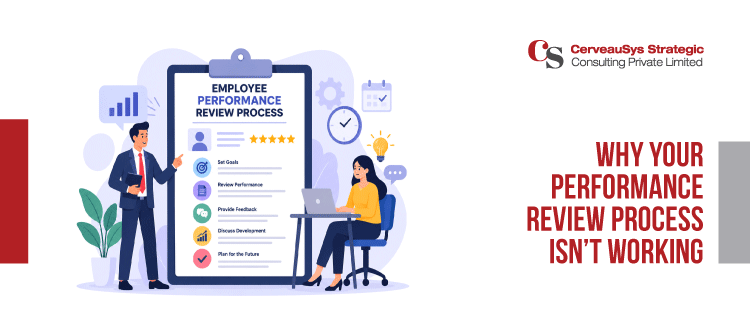
Why Your Performance Review Process Isn’t Working
You may have seen this before. The review cycle opens, managers scramble to fill out forms, employees sit through a meeting that feels more like a formality than a conversation, ratings get assigned, and then everyone moves on. A few weeks later, it is as if the review never happened.
If this sounds familiar, you are not alone. Most organizations run performance review cycles faithfully, year after year, and still wonder why engagement stays flat, why the same performance gaps keep resurfacing, and why employees rarely leave these conversations feeling clearer about their growth. The problem is not always the idea of a review itself. More often, it is how the process is designed, managed, and followed through.
Why Is My Organization’s Performance Review Process Not Working?
In most cases, a performance review stops working when it becomes an isolated event rather than part of an ongoing conversation. The review meeting itself is only as useful as the groundwork that leads up to it. From a management perspective, a review is meant to be a checkpoint, not the entire conversation. When it is treated as the only conversation, it carries far too much weight, and that is usually where things start to break down.
What Are the Common Problems With Performance Reviews?
There are a few patterns that show up again and again across organizations, regardless of industry or size.
Reviews happen only once or twice a year
When performance conversations are limited to one or two formal sittings a year, feedback arrives too late to be useful. A small issue that could have been corrected in a week is instead left to grow for months. By the time it surfaces in the review, it has often become a pattern rather than a moment, and patterns are harder to change than moments.
Employees are surprised by the feedback
In practice, nothing damages trust in a review process faster than an employee hearing something for the first time during their annual meeting. Feedback should never be a surprise. Managers who have regular, informal conversations throughout the year give their teams the chance to adjust course early, rather than discovering a concern only when it is written into a formal document.
The focus is too much on ratings
Ratings have their place, but when the entire conversation narrows down to a number, the real purpose of the review gets lost. Employee performance review tools can score consistently, but they cannot replace a discussion about contribution, development, and what success looks like going forward. When a number becomes the headline, everything else in the meeting becomes background noise.
Goals are unclear or disconnected from business priorities
Employees can struggle to perform well when they are not entirely sure what they are being measured against, or how their individual goals connect to what the business is trying to achieve. A goal that exists only on paper, disconnected from actual business priorities, gives people little to aim for.
Managers are not trained to conduct meaningful reviews
Being a capable manager in day-to-day operations does not automatically mean someone knows how to deliver difficult feedback, recognise genuine strengths, or hold a development conversation that feels honest rather than scripted. This is one of the most overlooked gaps in performance management, and it is rarely the manager’s fault. Performance evaluation often needs training and understanding of certain KPIs to measure.
The process becomes a paperwork exercise
Forms, templates, and systems exist to support the conversation, not replace it. When the priority shifts to completing the documentation correctly rather than having a genuine discussion, the performance review stops serving its purpose. What we often see in organizations is that the form gets completed perfectly while the conversation it was meant to support barely happens at all.
There is no follow-up after the review
The real value of a review is not in the meeting itself. It is in what happens afterward: whether goals are revisited, whether support is provided, and whether there is any accountability for the actions agreed upon. Without follow-up, even a well-run review conversation fades from memory within weeks.
The process is the same for everyone
A sales role, a technical role, and a leadership role rarely need to be measured or discussed in exactly the same way, yet many systems apply one template across the board. What matters for a frontline employee’s performance conversation looks quite different from what matters for a senior leader’s, and treating them identically often leaves both underserved.
Here’s a list of more concrete signs that your organization needs to revamp its performance management system.
What Makes a Performance Review Effective?
An effective performance review is built on a foundation of ongoing dialogue, clear expectations, and honest feedback, with the formal meeting simply confirming what has already been discussed along the way. It works when both the employee and manager walk in already knowing roughly what will be said..
How to Make Your Performance Review Process More Effective
Improving this process does not require reinventing it from scratch. It usually means adjusting a few structural habits.
- Move from annual reviews to regular, shorter performance conversations throughout the year.
- Set clear and measurable expectations at the start of each period, not halfway through it.
- Link individual goals directly to business priorities so employees understand the “why” behind their targets.
- Train managers to give feedback that is specific, balanced, and grounded in real examples.
- Make employee development an active part of the conversation, not an afterthought at the end.
- Use technology and employee performance review tools where they genuinely reduce admin and support better conversations, rather than adding another layer of process.
- Track agreed actions after every review so commitments do not quietly fade away.
- Review the process itself periodically, and adjust it based on feedback from employees and managers who actually use it.
How Often Should Performance Conversations Happen?
Performance conversations work best when they happen regularly, ideally monthly or quarterly, rather than being reserved for one or two formal reviews a year. Frequent, shorter conversations catch issues early and keep goals relevant as priorities shift.
At CerveauSys Strategic, another common question we hear is, “What Should Managers Do After a Performance Review?”
After a review, managers should document the agreed goals and development actions, check in on progress at regular intervals, and provide the support or resources needed to help the employee follow through. A review without follow-up rarely leads to lasting change.
Looking Beyond the Performance Review Process Itself
In practice, fixing a broken review process is rarely about redesigning the form. It is about examining the wider system: how goals are set, how managers are equipped to give feedback, how accountability is tracked, and how employee development connects to business outcomes.
This is often where an outside perspective helps. Organizations sometimes need performance management consultants to step in and identify blind spots in their existing approach, simply because it is difficult to see structural gaps from inside the system every day.
CerveauSys Strategic works with leadership teams on exactly this kind of system-level review, looking at goals, manager capability, feedback culture, and accountability together rather than in isolation. As a performance management consulting firm in Pune, we often find that the review meeting itself is the smallest part of the problem, and the bigger opportunity lies in the structure surrounding it.
If your performance reviews have started to feel like a formality rather than a genuine driver of performance, it may be worth stepping back and looking at the system behind them, not just the form. That is usually where the real answers are.
Is your current performance review process actually helping people perform better, or simply completing a task on the calendar? Let’s amplify the role of performance reviews in your organization.