
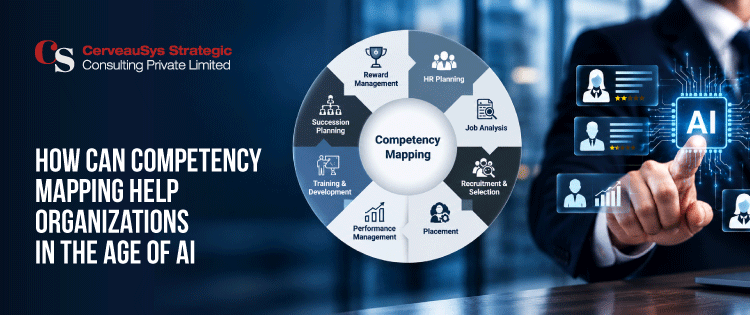
How Can Competency Mapping Help Organizations in the Age of AI?
AI is changing how work gets done. Some tasks are being automated, some roles are shifting, and employees are being asked to work with tools they did not use a year ago. For leaders, this raises a practical question: do our employees have the competencies we will need for what comes next?
Most organizations cannot answer that with confidence. Competency mapping offers a structured way to find out. It identifies the knowledge, skills, behaviours, and capabilities each role requires, then compares them with what employees currently have, so you can see where the distance between the two is growing.
When roles and tools change quickly, the competency map has to be revisited regularly. Used thoughtfully, AI and competency mapping can work together to give organizations a clearer view of current capabilities and future needs, while the judgement about what matters for the business stays with people. Recent research on AI-driven competency mapping in IT organizations makes a similar point: employees see promise in AI, but they also want accuracy, transparency, and a human-centered approach.
6 Ways Competency Mapping Helps Organizations in the AI Era
1. Identifying Emerging Skill Gaps
Competency mapping helps organizations compare employees’ current capabilities with what new, AI-enabled roles demand. If we analyze carefully, competency mapping and skill gap analysis work as a pair: the map defines what is needed, and the analysis shows where employees fall short.
Take a finance team that starts using AI tools to prepare reports. The task of compiling numbers shrinks. The need to question the output, spot errors, and explain findings to non-finance colleagues grows. Without competency mapping, the gap shows up later as poor decisions or rework. With it, the team sees the gap early.
2. Enabling Targeted Upskilling and Reskilling
Many organizations still send everyone to the same workshop and hope it helps. It rarely does, because people start from different places.
Competency mapping replaces that guesswork with four clear answers:
- Who needs development
- Which competency needs improvement
- What the employee’s current proficiency level is
- What level the role actually requires
That sounds simple, but it matters. An employee who is already strong in data interpretation does not need a beginner course on it. Another who struggles with it does. Development becomes focused, relevant, and far more likely to be used on the job.
3. Redesigning Roles for Human-AI Collaboration
AI rarely removes a job in one stroke. More often it changes the mix of tasks inside the job. A recruiter may spend less time screening resumes and more time assessing fit, advising hiring managers, and building candidate relationships.
Competency mapping helps you see that shift clearly. You can look at a role, separate the tasks AI can support from those that need a person, and ask which human capabilities now carry more weight. Judgement, communication, problem-solving, collaboration, creativity, and decision-making tend to rise in importance because they sit in the work AI cannot do alone. The practical output is a role description that reflects reality, along with a clear view of what to build in the people doing it.
4. Improving Talent Deployment and Internal Mobility
Job titles describe where someone sits, not what they can do. Competency mapping in talent management looks past the title to the capabilities underneath.
Think about it this way. A customer support executive with strong analytical thinking and clear writing skills may be a good fit for a quality or content role, even though nothing in their title suggests it. Mapping makes those transferable competencies visible. Organizations can then match people to new roles and projects from within, which supports internal mobility and makes better use of talent they already employ and trust.
5. Supporting Future Workforce Planning
A workforce competency assessment gives leaders something they often lack: reliable information. Once you know which competencies you have, which you lack, and which will grow in importance, the decisions get clearer. You can weigh options such as:
- Developing existing employees
- Hiring new talent
- Redeploying people to different roles
- Redesigning roles
- Supporting employees with AI tools
Not every gap calls for a new hire, and not every gap calls for training. Sometimes the right answer is to redesign the work. Mapping lets leaders choose based on evidence, and keeps the conversation on workforce strategy rather than on which tool to buy next.
6. Connecting Competencies to Business Performance
Training completion is easy to count. It tells you little about whether anything improved.
Here’s where the real value comes in. Competency mapping lets you track whether stronger competencies lead to better results in areas such as productivity, quality, decision-making, innovation, and customer outcomes. The logic runs in a line: competency development builds better employee capability, better capability improves performance, and better performance moves organizational outcomes.
That is why competency mapping is not only an HR exercise. Business leaders can use it to see whether their investment in people is paying off, and to direct that investment where it matters most.
Competency Mapping with AI means Better Workforce Decisions
AI is changing what competency mapping can deliver. It analyses skills data across your teams in a fraction of the time, spots emerging gaps early, and keeps your competency framework current as roles evolve. The result is a sharper view of your people and far better decisions on development, deployment, and hiring.
At CerveauSys Strategic, the best Competency Mapping and Assessment Firm in Pune, we combine this technology-enabled approach with decades of consulting experience. We help you identify the competencies that matter most, understand where your workforce stands today, and build the capabilities your business will need tomorrow.
Ready to make your workforce future-ready? Partner with CerveauSys Strategic for competency mapping that turns workforce insight into real business results. Connect with our team today and take the first step.

Competency mapping is the process of identifying the knowledge, skills, abilities, and behaviours required for different job roles. It helps organizations assess employee capabilities, identify skill gaps, and ensure that the workforce has the competencies needed to achieve business objectives.
Competency mapping is important in the age of AI because technology is changing job responsibilities and the skills employees need. It helps organizations identify emerging skill gaps, prepare employees for AI-enabled roles, improve workforce productivity, and build future-ready teams.
AI helps competency mapping by analysing workforce data, identifying skill patterns, highlighting competency gaps, and supporting personalized employee development plans. It can also help HR teams understand changing skill requirements and make more informed talent management decisions.