How Does Organizational Transformation Improve Business Performance?
Picture a company that crossed 100 crores in revenue, hired more people, added new products, and still felt slower than it did five years ago. Decisions take longer. Teams work hard but pull in different directions. Customers notice the friction before leadership does.
Customers compare you with the best experience they have ever had, not with your competitor down the road. Talent expects clarity and growth, not just a salary. In that environment, working harder stops being a strategy. You cannot out-effort a broken system.
As the best strategy and management consulting firm in Pune, we believe this is where organizational transformation makes all the difference. Not as a one-time project, but as a structured way of rebuilding how a business thinks, decides, executes, and grows. Done well, it changes performance at the root rather than at the surface.
What is Organizational Transformation?
Organizational transformation is the deliberate redesign of a company’s strategy, structure, processes, people systems, and culture so the business can perform at a higher level consistently. It is not a single initiative. It is a shift in how the organization operates.
Many leaders confuse it with change management. The difference matters.
- Change management helps people adjust to a specific change, such as a new ERP system or a new reporting structure.
- Organizational transformation questions the design itself. Are our roles clear? Does our structure support our strategy? Do our processes create speed or friction?
Think about it this way. Change management is repairing a room. Business transformation is redrawing the blueprint of the house.
Transformation is also continuous rather than finite. Your market keeps evolving, so your operating model has to evolve with it. Companies that treat transformation as a project finish it and slide back. Companies that treat it as a capability keep compounding gains.
How does organizational transformation improve business performance?
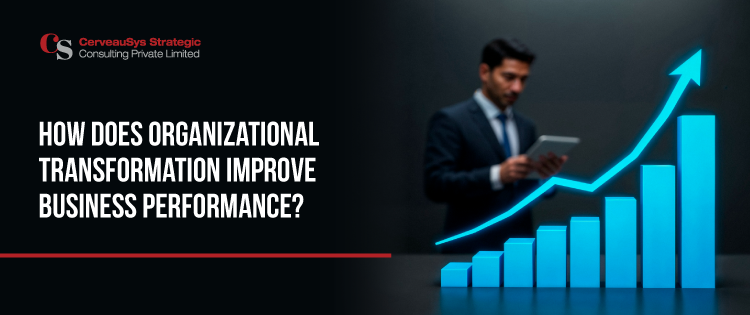
It improves performance by removing the structural reasons behind poor execution. When roles, accountability, processes, data, and leadership behaviour are aligned, the same team delivers significantly more output with less friction.
Here is where the impact usually shows up.
Better decision making: Clear ownership means decisions happen at the right level instead of travelling up and down the hierarchy.
Improved productivity: Redesigned processes cut rework, duplication, and waiting time. Most teams are not lazy. They are stuck inside inefficient workflows.
Stronger leadership: Transformation forces leaders to move from firefighting to designing systems, reviewing performance, and coaching people.
Better customer experience: Internal alignment always shows up externally. Faster response times, fewer errors, more consistency.
Higher employee engagement: People stay engaged when expectations are clear and progress is visible. Ambiguity drains motivation faster than workload does.
Faster adaptation: A well-designed organization absorbs market shifts instead of being disrupted by them.
Innovation and operational excellence: When teams stop drowning in daily chaos, they finally get room to improve and innovate.
Let’s understand this with an example.
A mid-sized manufacturing company was missing delivery timelines regularly. Leadership teams assumed it was a capacity problem and considered a new plant. A deeper review showed something else. Sales committed dates without checking production load, procurement worked on outdated forecasts, and nobody owned the end-to-end order cycle.
The fix was not more capacity. It was a redesigned planning process, one accountable owner per order stage, and a weekly review rhythm with real numbers. On-time delivery moved from 68 percent to 91 percent in two quarters. No new investment. That is genuine business performance improvement.
In reality, most companies are sitting on hidden capacity that poor design keeps locked up.
What role does strategic business planning play in successful transformation?
Strategic business planning gives transformation direction and discipline. Without it, transformation becomes a set of disconnected initiatives that consume energy and produce little measurable change.
Strong strategic business planning does a few essential things.
- Sets measurable goals: Vague ambition cannot be managed. Specific targets can.
- Aligns teams: Every function should be able to explain how its work connects to the company goal.
- Allocates resources honestly: Transformation needs budget, time, and attention. Priorities must be chosen, not stacked.
- Defines KPIs: You need leading indicators, not just year-end results.
- Builds long-term sustainability: Plans should hold up across cycles, not only in good quarters.
- Demands leadership commitment: This one decides everything.
When leadership treats transformation as a delegated task, it stalls. When leaders visibly own it, review it, and hold themselves to the same standards, the organization follows. This is where good strategic management consultants in Pune earn their place. They do not hand over a report and leave. They stay until the systems work.
At CerveauSys Strategic, our approach is built around this belief. Our team works with leadership to diagnose root causes, redesign operating structures, align leadership teams, strengthen execution frameworks, and build performance systems that scale.
That combination of diagnosis, design, and disciplined execution is why many high net worth companies consider CerveauSys Strategic for strategy and management consulting in Pune.
Ready to Build a Stronger Business?
Transformation is not just a technology upgrade or an organization restructuring exercise. It is the alignment of people, processes, and strategy into one working system. Companies that keep evolving build predictable performance. Companies that resist change spend their energy managing the same problems every year.
If your business is growing but execution feels heavier than it should, that is usually a signal worth examining. Structural issues rarely resolve themselves. Connect with CerveauSys Strategic to explore how a structured transformation approach can build sustainable growth and long-term business performance.
What is organizational transformation?
Organizational transformation is the process of fundamentally changing how a company operates to improve performance and achieve long-term business goals. It can involve changes to business strategy, organizational structure, processes, leadership, technology, employee capabilities, and workplace culture. Unlike a one-time change initiative, transformation focuses on creating a more adaptable and effective organization that can continuously respond to market and customer needs.
How does organizational transformation improve business performance?
Organizational transformation improves business performance by aligning strategy, people, processes, leadership, and resources around common business goals. It can help organizations make faster decisions, eliminate inefficient processes, improve employee productivity, strengthen accountability, enhance customer experience, and respond more effectively to market changes. When these elements work together, businesses can reduce operational friction while creating more consistent and sustainable growth.
Why is organizational transformation important for business growth?
Organizational transformation is important because businesses often outgrow the structures and processes that supported their earlier success. As companies expand, unclear responsibilities, inefficient workflows, slow decision-making, and disconnected teams can limit growth. Transformation helps redesign these areas so the organization can scale effectively, adapt to changing market conditions, improve operational efficiency, and build the capabilities needed for sustainable long-term growth.