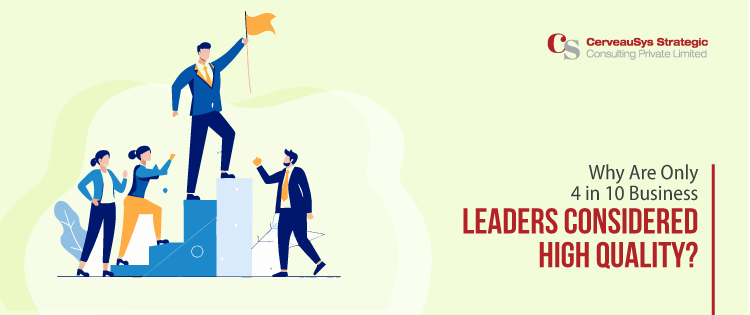
Why Are Only 4 in 10 Business Leaders Considered High Quality?
A few months ago, a manufacturing company in Pune asked a simple question during our initial review meeting. Sales targets were being met. The order book looked healthy. Yet three senior managers had resigned in six months, and two more teams were quietly missing deadlines. The leadership team assumed it was a market problem.
It was not. It was a leadership quality problem. Many businesses don’t recognize these warning signs until they begin working with experienced leadership development consultants.
Let’s understand why this happens, and what can be done about it.
Why do so many business leaders struggle to become effective leaders?
Most people are promoted because they were good at their job. Not because they were prepared to lead others.
That single fact creates most of the problem.
Leadership and management are not the same thing. Management is about controlling work. Planning, tracking, reviewing, correcting. Leadership is about direction and belief. Where are we going, and why should anyone follow? Many senior professionals master the first and never build the second. So they manage tasks well and lead people poorly.
Then there is self-awareness, or the lack of it. You may have noticed that the leaders who receive the most complaints are often the ones most surprised by feedback. They do not see their own impact. A sharp tone in a meeting feels like efficiency to them and feels like humiliation to the person receiving it. Without honest feedback loops, blind spots harden into habits.
Communication is the next gap. Strategy is usually clear at the top and blurry three levels down. When people do not understand priorities, they invent their own. Effort gets spent, but not in the same direction. Reactive decision-making adds to the damage. Firefighting feels productive. It is also exhausting. When leaders spend their week solving yesterday’s problems, nobody is designing tomorrow’s business.
And finally, many leaders simply cannot inspire. They can instruct. They can escalate. But they cannot make work feel meaningful. That is where many organizations struggle, because discretionary effort is voluntary. People give it to leaders they respect.
Poor leadership effectiveness is rarely about intent. It is about capability that was never built.
How does leadership quality affect business performance?
According to leadership research by Gallup, around 82% of leaders lack high-level talent for leading people. It’s no surprise, then, that only about four in ten business leaders are considered high quality by the teams who work with them. The remaining six out of ten are seen as average, inconsistent, or difficult to follow. That gap explains why even organizations with strong strategies often struggle to turn plans into results.
Leadership influences almost every part of a business. It shapes how people work, how teams collaborate, and how customers experience your organization. In many cases, the difference between a business that grows consistently and one that struggles comes down to the quality of its leaders.
Employee engagement starts with the manager, not the company logo. People are more likely to stay motivated when they feel supported, heard, and trusted by their leaders. In fact, many employees leave because of poor management rather than the organization itself.
Productivity also depends on strong leadership. When goals are clear, responsibilities are well defined, and decisions are made on time, teams can focus on doing their best work. But when leaders fail to provide direction, even talented employees lose momentum, resulting in delays, confusion, and repeated mistakes.
Innovation thrives in an environment where people feel safe to speak up. Great leaders encourage questions, welcome new ideas, and treat mistakes as learning opportunities. When employees fear criticism or blame, creativity fades, and opportunities for improvement are lost.
The reality is that leadership quality shows up in margins, attrition, and delivery timelines. That’s why many organizations choose to work with leadership development consultants.
How can organizations develop better leaders?
Good news. Leadership is learnable. But it has to be built with structure, not left to experience alone.
Start with honest assessment: Use validated leadership assessments and 360-degree feedback to see the actual picture. Opinion is not data.
Map competencies to strategy: Define the behaviours your business plan requires over the next three years. A company entering exports needs different capabilities than one consolidating operations. Competency mapping makes development specific rather than generic.
Use coaching where it matters most: Leadership coaching works best for senior roles where behaviour change is personal and context heavy. One good coach often outperforms ten workshops.
Build structured leadership development programs: Cohort-based leadership development programs create shared language across the organization. Blend classroom learning with real business projects so learning is applied, not stored.
Make learning continuous. Skills fade. Quarterly reinforcement, peer learning groups, and manager check-ins keep new habits alive.
Connect it to organizational transformation: Leadership development consulting delivers little value if the surrounding system rewards old behaviour. Review how performance is measured, how decisions are approved, and how information flows. Change the system, and behaviour follows.
Many organizations reach a point where internal efforts aren’t enough. An experienced consulting partner can provide an objective view, identify leadership gaps, and build development programs that align with business goals. That’s where working with the best leadership development consulting firm in Pune can make a meaningful difference.
Build a Strong Business Leadership That Lasts
Markets will change, and business challenges will come and go. But organizations with strong leaders are better prepared to adapt, inspire their teams, and keep moving forward with confidence.
At CerveauSys Strategic, we work with organizations to strengthen leadership capability and align people with business strategy. The work spans executive leadership development, competency frameworks, leadership guidance, and organizational transformation. The aim is simple.
Make good leadership a system, not a coincidence. Invest in leadership today, and you build a stronger business for tomorrow.