
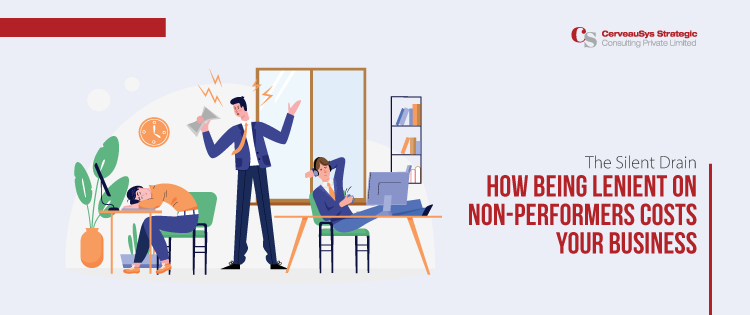
There is probably someone on your team right now who is not delivering what they should. Maybe they miss deadlines more often than not. Maybe their work is always just good enough to avoid a serious conversation. Maybe you have noticed other team members quietly picking up their slack without saying a word. And yet, nothing changes.
Most leaders have been there. You know something needs to be addressed, but you keep waiting. Maybe things will improve next quarter. And while you wait, the damage quietly begins.
This is what we at CerveauSys Strategic call the silent drain. It does not show up on your balance sheet overnight. It does not trigger an emergency meeting. But slowly, steadily, it hollows out your team, your culture, and eventually your business. Let us help you recognize that drain before it becomes a flood.
The Cost Nobody Notices at First
At first, it may not seem like a big issue. One person underperforming in a team of ten does not look catastrophic on paper. Work still gets done. Clients are still reasonably happy. Numbers are not alarming yet.
But over time, things start changing.
The good performers on your team, the ones you rely on most, start carrying more than their fair share. They finish their own work and then quietly fix what the non performer left incomplete. They stay late. They cover gaps. And they do it without being asked because they care about the team.
But they are also watching. They see who is being held accountable and who is not. They see that effort and mediocrity are being treated the same way. Missed deadlines become normal. Accountability starts feeling optional. The standard that everyone was once held to begins to blur.
And this erosion is almost invisible to leaders who are too close to the situation to notice it building.
Why Leaders Delay Tough Decisions
Here is something not enough people talk about. Most leaders who avoid addressing non performance are not bad leaders. They are human.
There is guilt involved. Maybe you hired this person yourself. Maybe they have been loyal for years even if their output has declined. Maybe they shared a difficult personal story and you do not want to seem heartless.
There is also hope. You keep believing that the next review cycle, the next project, the next month will be the turnaround. You give second chances, then third ones, and somewhere along the way the problem becomes so normalized that addressing it feels even harder.
And then there is the fear of confrontation. Difficult conversations are uncomfortable. No one enjoys delivering hard feedback, especially when they genuinely like the person. So leaders avoid the conversation and manage around the problem instead, hoping it resolves itself.
It almost never does.
The Financial Impact on Business Growth
Non performance is not just a people problem. It is a business problem with real financial consequences. When deadlines are missed, client satisfaction takes a hit. When quality slips, you spend time and money on rework and damage control. When your best people burn out or leave because they feel unsupported, you face the costs of recruitment, onboarding, and lost institutional knowledge.
Revenue leakage is very real in this scenario. Projects that should take two weeks take four. Opportunities that require sharp, fast execution get delayed. Teams that should be scaling are instead spending energy compensating for weak links.
And none of this ever appears as a single line item in your financial reports. It is spread across lost productivity, hidden inefficiencies, and the slow erosion of what your business could have been.
What Effective Performance Management Actually Looks Like
Effective performance management is not about being harsh or clinical. It is about being clear.
It means every team member knows exactly what is expected of them and how their performance will be measured. It means feedback is given regularly, not just during annual reviews. It means when someone is struggling, there is a structured, supportive process to identify the gap and work toward improvement.
It also means that when improvement does not happen despite genuine support, leaders have the courage and the framework to make the right call for the organization.
Good performance management is ultimately an act of respect. Respect for your business, for your high performers, and even for the individual who is struggling. Clarity is kinder than ambiguity in the long run.
How Expert Guidance Helps Organizations
Building a performance culture is not something that happens automatically. It requires intentional design, leadership alignment, and often, an outside perspective. This is where working with a trusted performance management consulting firm in Pune can make a significant difference.
At CerveauSys Strategic, we work with founders, CEOs, HR leaders, and management teams across industries to help them build organizations where performance is not just expected but genuinely supported.
We help you put the right systems in place so that conversations around accountability feel structured and fair rather than personal or awkward. We help leaders develop the confidence and tools to address performance issues early before they grow into larger organizational challenges.
Our work as experienced performance management consultants in Pune goes beyond frameworks. We focus on building cultures where people feel motivated to perform, where leadership is seen as fair and consistent, and where growth is tied directly to contribution.
The Bottom Line
Protecting your business from the silent drain is one of the most important responsibilities you carry as a leader. The non performer you are tolerating today is not just a performance issue. They are quietly shifting your culture, exhausting your best people, and costing your business in ways that may take months or years to fully surface.
Addressing it is not about being ruthless. It is about being responsible. To your business, to your team, and to the standard that everyone deserves to work within.
At CerveauSys Strategic, we believe that great organizations are built on clarity, accountability, and the courage to have the conversations that matter. If you are sensing the silent drain in your organization, do not wait for it to get louder. Reach out to us and let us help you build the kind of performance culture your business truly deserves.
And the best time to act on performance was yesterday. The next best time is right now. Get in touch with us!
The best way to deal with non-performing employees is through a structured performance management process. Set clear expectations, provide regular feedback, identify skill gaps, offer support and training, and establish measurable improvement goals. Addressing performance issues early helps maintain team morale, prevents burnout among high performers, and promotes a culture of accountability.
Poor employee performance can significantly affect business growth by reducing productivity, delaying projects, increasing operational costs, lowering employee engagement, and impacting customer satisfaction. Over time, unresolved underperformance can lead to revenue loss, higher employee turnover, and a decline in overall organizational performance.
Performance management is important because it aligns employee goals with business objectives, improves accountability, enhances productivity, and supports employee development. An effective performance management system helps organizations identify performance gaps early, retain top talent, and build a high-performing workplace culture that drives sustainable business growth.